Workflow Automation & System Integration
Workflow Automation & System Integration Summary
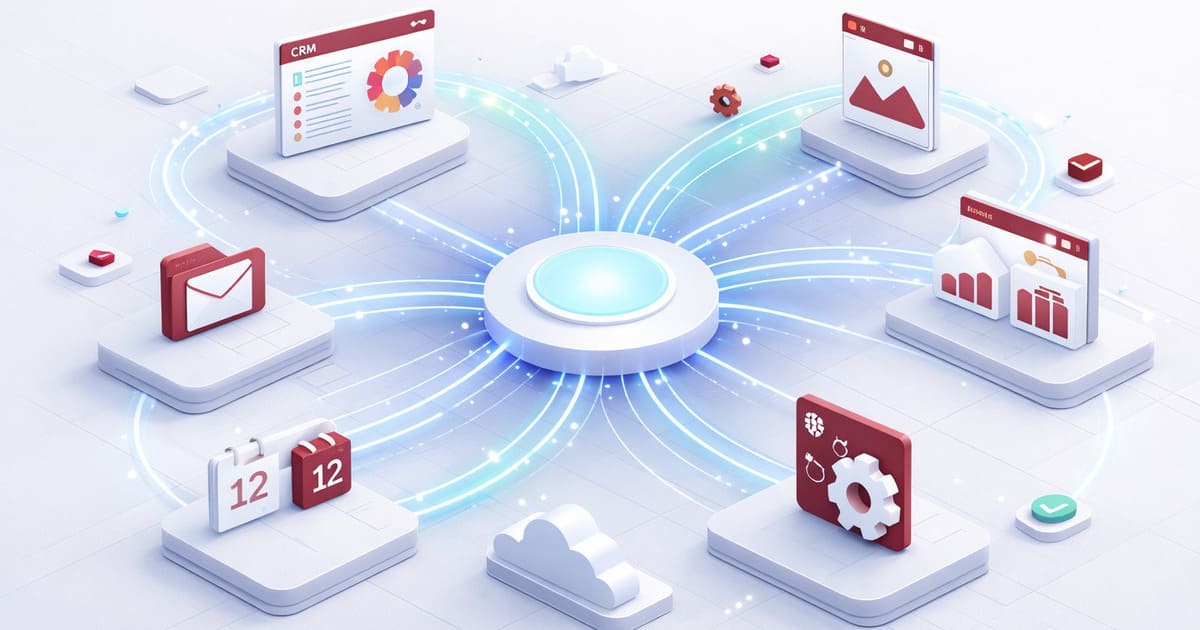
Workflow automation and system integration remove manual handoffs by linking business tools into a single execution fabric.
Data, actions, and state changes move continuously between platforms instead of stalling in queues, inboxes, or brittle scripts.
AI-driven orchestration governs flow, resolves conditions, and maintains stability as operational complexity increases.
-
Best for: Organizations coordinating work across CRMs, ERPs, internal tools, and external platforms
-
Delivers: AI-orchestrated workflows, durable integrations, and real-time cross-system execution
-
Outcomes: Fewer failures, faster operations, and systems that stay synchronized without human chasing
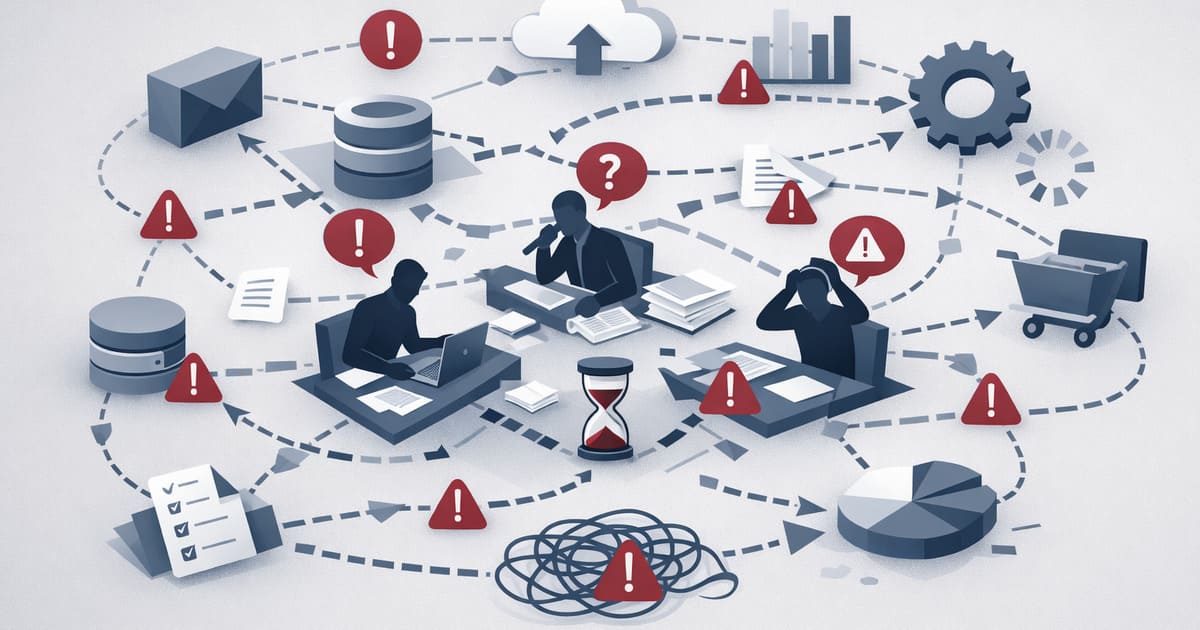
Operations rarely fail loudly—they erode quietly through disconnected systems and manual handoffs.
Work drifts between platforms without ownership, validations depend on memory instead of logic, and outcomes vary based on who intervenes.
As volume grows, teams monitor queues, reconcile conflicting records, and apply fixes simply to keep momentum from stalling.
Workflow Automation & System Integration restores execution flow.
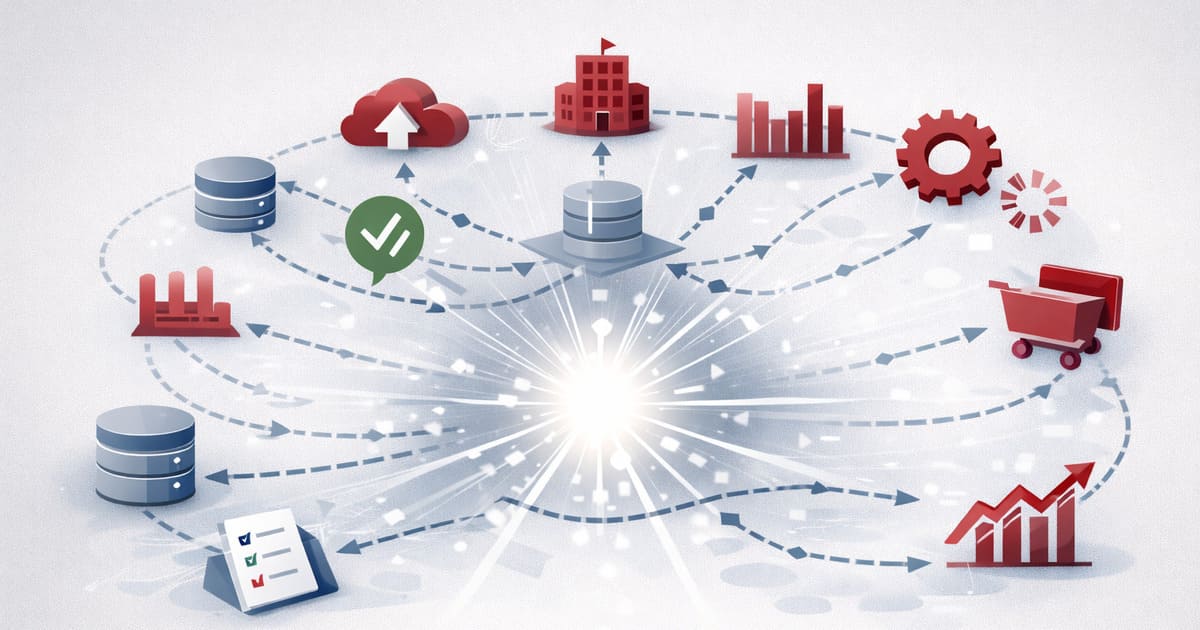
We connect systems into continuous workflows where data moves, actions trigger, and states advance automatically.
AI-directed logic governs transitions, resolves conditions, and keeps execution aligned as tools interact in real time.
For complex environments, integrated workflows replace fragile point connections with durable coordination—logic adapts as platforms change,
preventing breakage as scale and scope expand.
For lean teams, automation removes constant oversight—systems remain synchronized, execution stays visible,
and leadership sees live operational truth instead of delayed updates.
The Challenge: When Operations Depend on Manual Handoffs
Workflow failures rarely appear as outages. They surface as delays caused by human routing, conditional checks,
and approvals that interrupt execution under pressure.
Most organizations already operate capable tools—CRMs, ERPs, internal platforms, reporting layers.
The friction emerges between them, where data transfer, action sequencing, and responsibility rely on people instead of enforced logic.
Over time, confidence erodes. Records diverge, throughput slows, and decision-makers hesitate because system signals no longer reflect live reality.
The Hidden Cost of Human-Driven Workflow Choices
Each manual touchpoint compounds latency, inconsistency, and systemic drag across execution.
-
Incoming items arrive untyped, forcing reroutes, pauses, and corrective loops.
-
Reviews shift by role or moment, producing variance, queues, and stalled throughput.
-
Edge cases circulate through chats and alerts rather than enforced execution rules.
-
Dashboards mirror lagging fragments, eroding trust in operational signals.
Breakdowns stay subtle. Coordination grows brittle, expansion slows, and continuity depends on constant human attention to remain acceptable.
Why Integrated Systems Lose Alignment Over Time
Operational platforms rarely break from lack of capability. Effectiveness declines when real-world conditions shift
faster than the rules controlling flow, sequencing, and coordination.
As execution patterns change, environments begin accumulating:
-
Inputs arriving without enforced evaluation, allowing ambiguity to enter execution paths
-
Automations operating blindly, continuing sequences despite shifting context or constraints
-
Temporary patches evolving into permanent dependencies across daily execution
Without embedded intelligence governing flow, platforms degrade into historical ledgers,
recording activity after completion instead of directing outcomes as work unfolds.
The Solution: Workflow Automation & System Integration
Rather than depending on people to steady fragile connections, execution logic is embedded directly where systems interact.
Platforms coordinate actions continuously, while humans remain focused on oversight and exception handling.
Workflow automation and system integration convert isolated tools into a unified execution fabric.
Data movement, state changes, conditional logic, and synchronization occur inside workflows—without chasing updates or manual triggers.
This approach stays deliberately focused. Orchestration is applied only where interruptions, variance,
or reliability risk repeatedly surface.
Connected Intake and Intelligent Routing
Incoming activity is evaluated and directed automatically using context, conditions, and live system signals
instead of manual sorting.
We design routing layers that:
-
Distribute tasks using priority, capacity awareness, and operational constraints
-
Rebalance flow dynamically as volume, availability, or dependencies change
-
Modify routing logic without interrupting downstream execution
Work stops queuing aimlessly and begins moving as a coordinated system.
Automated State Advancement and Verification
When accuracy relies on memory or reminders, system truth inevitably drifts.
We implement controls that:
-
Advance records using confirmed actions and system-generated signals
-
Validate completeness and coherence continuously during execution
-
Block incomplete or invalid states from propagating across platforms
System status remains aligned with reality without corrective follow-up.
Automated Follow-Through and Execution Continuity
Critical actions progress automatically rather than stalling inside inboxes or task queues.
-
Trigger steps precisely when workflow conditions resolve
-
React to document changes, approvals, system events, or elapsed intervals
-
Execute defined sequences without manual coordination
Progress remains uninterrupted even as scale and complexity expand.
Operational Visibility Anchored in Verified Activity
When execution logic governs flow, insight becomes observable rather than interpretive.
We build visibility layers that:
-
Calculate indicators exclusively from confirmed system behavior
-
Refresh metrics continuously as work advances across tools
-
Present execution reality without inference or manual adjustment
Dashboards evolve into control surfaces instead of historical summaries.
How It Works: Workflow Automation & System Integration
Effective automation is intentional, not expansive. Rather than wiring everything together,
execution is reinforced precisely where interruptions, latency, or variance recur.
The method reflects how resilient operations actually run—defined stages, enforced progression,
and systems that sustain continuity without relying on memory or follow-ups.
Mapping Real Execution Paths
We begin by tracing how activity genuinely moves across the organization:
-
Entry points where requests, records, or events enter platforms
-
Progression through evaluation, verification, and execution layers
-
Completion, downstream handoff, or oversight checkpoints
This exposes where teams compensate for weak transitions, where signals degrade,
and where momentum drops without visible cause. Tools remain secondary—continuous execution is the goal.
Applying Intelligence Where Stability Emerges
Automation is never universal. Only activities that repeatedly introduce delay,
inconsistency, or execution risk are selected.
We identify:
-
Predictable decisions suited for consistent, logic-driven handling
-
Recurring actions that quietly undermine reliability when performed manually
-
Workflow checkpoints appropriate for AI-guided evaluation and sequencing
Intelligence is introduced selectively to strengthen accuracy, preserve flow,
and retain control without adding operational burden.
Assemble, Validate, and Activate
Automation is implemented and activated across:
-
Financial, operational, and internal execution platforms
-
Workforce, compliance, and people-operations environments
-
Any internal system required to advance operational activity
Each workflow is validated under live conditions, observed in motion, and documented to prevent regression.
Execution remains dependable as teams, volume, and priorities change.
The Benefits of Workflow Automation & System Integration
When execution is governed by embedded coordination rather than individual follow-up,
operations stabilize. Progress becomes consistent, interruptions diminish, and growth no longer amplifies friction.
At this point, automation stops acting as support and becomes the foundation of daily execution.
Execution Accelerates as Friction Disappears
By eliminating manual coordination, flow improves and teams concentrate on forward motion.
-
Teams move from managing transfers to advancing measurable outcomes
-
Actions execute reliably without reminders, escalation paths, or manual tracking
-
Task sequencing adjusts automatically using priority, logic, and live conditions
Internal platforms reinforce momentum instead of interrupting progress.
Leadership Gains Dependable Operational Insight
When system state updates autonomously, reporting shifts from interpretation to observation.
-
Immediate visibility into execution status across interconnected tools
-
Fewer late-stage surprises during reviews, audits, or reporting cycles
-
Decisions anchored in verified system output rather than assumption
Leadership focus shifts from validating information to steering execution.
A Self-Maintaining Operational Backbone
Integrated workflows continue functioning as volume fluctuates, responsibilities change, or priorities shift.
-
Execution rules enforce themselves without constant oversight
-
Data integrity remains intact through continuous automated validation
-
Throughput increases without proportional headcount expansion
Operations become predictable—steady, controlled, and intentionally uneventful.
Why Our Workflow Automation & System Integration Is Different
Many automation efforts concentrate on surfaces—interfaces, forms, permissions, dashboards.
Useful, but incapable of changing how execution truly behaves.
This service focuses on the mechanics of delivery—how work advances, how logic governs transitions,
and how results materialize inside connected platforms.
We design environments where correct outcomes occur by default.
Decision rules live inside workflows, validation persists continuously,
and automated execution is treated as core infrastructure rather than an accessory.
The difference becomes apparent quickly:
-
Fewer exceptions requiring manual correction or escalation
-
Reduced rework introduced after execution has already progressed
-
Fewer review cycles triggered by stalled, unclear, or partially completed activity
Core platforms evolve from passive record keepers into active execution engines.
This is not about interface polish.
It’s about restoring dependability to operational results.
Stabilizing Operations Through Automated Execution
Unreliable outcomes typically originate from fragmented coordination,
not limited capability or insufficient commitment.
Workflow automation and system integration substitute human oversight with embedded control logic,
directing activity progression across connected platforms while continuity persists without supervision.
This represents a shift from intention-led management toward engineered operational reliability.