AI-Assisted Operations Automation
AI-Assisted Operations Automation Summary
AI-assisted operations automation embeds intelligence directly into operational workflows to support classification,
validation, and decision-making at scale. Instead of removing humans from the loop, AI handles repetitive judgment calls,
enforces consistency, and escalates only what requires human oversight—reducing errors while keeping control exactly
where it belongs.
-
Best for: Teams running complex operational workflows across multiple systems
-
Delivers: AI-supported decision workflows, automated validation, and consistent execution
-
Outcomes: Fewer errors, faster decisions, and more human time saved without sacrificing control
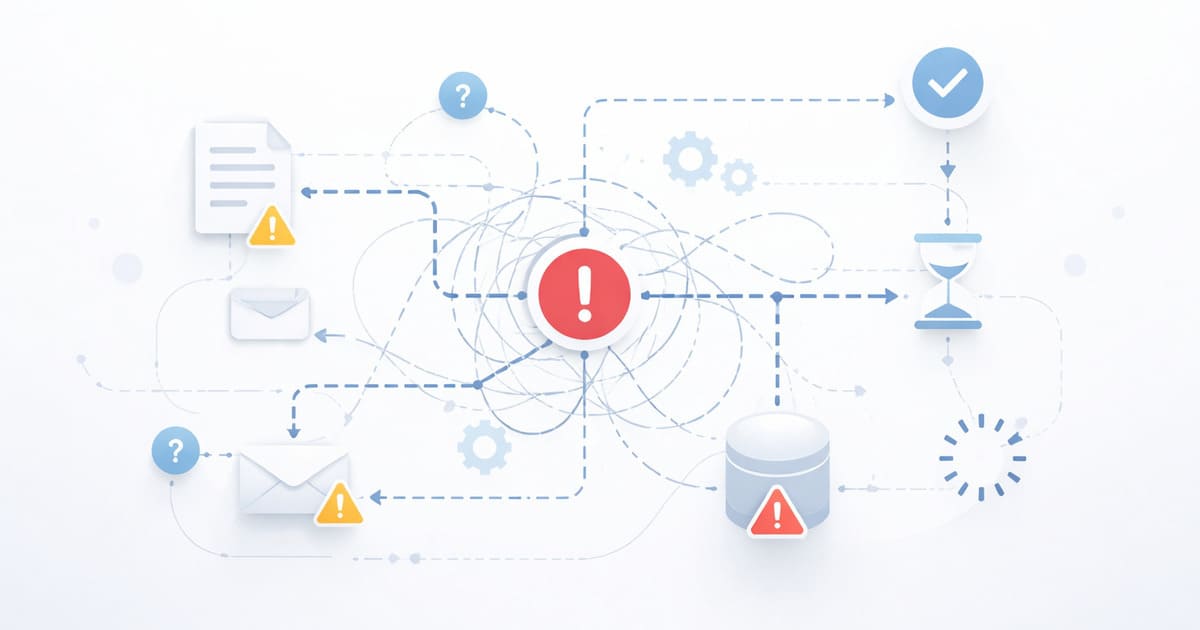
Operations teams aren’t inefficient—they’re constrained by systems that rely on manual decisions, disconnected tools, and fragile human handoffs.
Requests move between systems without clear ownership, validations depend on tribal knowledge, and decisions are made inconsistently under pressure.
When volume increases, teams chase status updates, reconcile mismatched data, and intervene manually just to keep operations running.
AI-Assisted Operations Automation restores control and consistency.
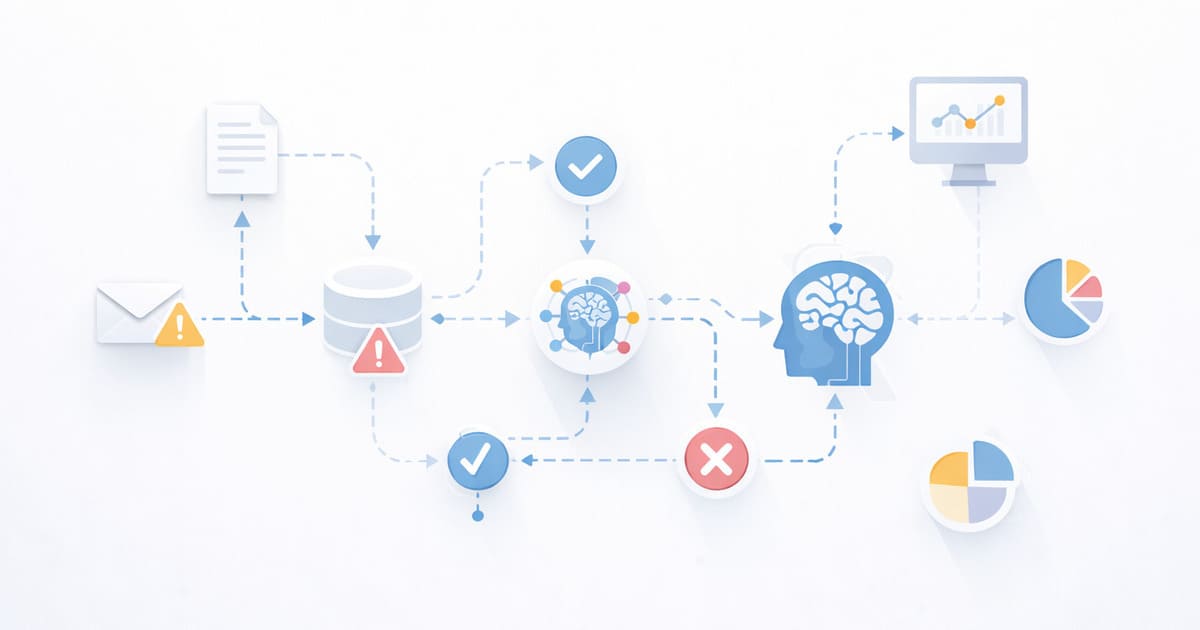
We embed AI directly into operational workflows to handle classification, validation, and decision support in real time.
Workflows route intelligently, data is verified automatically, and exceptions are surfaced only when human judgment is required.
For complex organizations, this creates resilient operations that scale without constant oversight—AI-enforced rules replace manual policing,
and systems remain stable as volume and complexity increase.
For lean teams, AI-assisted operations deliver immediate visibility and reliability without adding operational overhead—systems explain their own state,
decisions are traceable, and leadership sees what is actually happening, not what was last updated.
The Challenge: When Operations Depend on Human Judgment
Operational workflows rarely collapse outright. Instead, they slow down through manual decision points,
inconsistent validations, and processes that rely on people to interpret, route, and approve work under pressure.
Most organizations already run capable operational systems—financial platforms, internal tools, data pipelines,
and reporting layers. The problem is not the technology itself, but the gaps between systems where humans are
forced to classify inputs, verify information, and decide what happens next.
Over time, this creates uncertainty. Data becomes harder to trust, execution loses momentum, and leadership
hesitates because operational signals no longer reflect reality.
The Hidden Cost of Manual Operational Decisions
Every human-dependent decision introduces delay, variation, and cumulative operational friction.
-
Work enters systems without consistent classification, causing routing delays and unnecessary rework.
-
Validation and approval steps vary by individual, creating unpredictable outcomes and bottlenecks.
-
Exceptions are handled through messages and reminders instead of enforced operational logic.
-
Reports reflect delayed or partial inputs, weakening confidence in operational decision-making.
Nothing fails dramatically. Systems simply become harder to manage, harder to scale, and increasingly dependent
on human effort just to maintain acceptable performance.
Why Operational Systems Drift Over Time
Most operational platforms do not fail due to missing features. They lose effectiveness when business reality
changes faster than the logic that governs decisions, checks, and process flow.
As workflows evolve, systems begin to accumulate:
-
Incoming information that is no longer assessed or verified in a consistent way
-
Process automations that continue to run without awareness of changing operational conditions
-
Short-term fixes that quietly become critical paths in daily operations
Without intelligence embedded into workflow execution, systems gradually become passive repositories—
capturing events after they occur rather than shaping outcomes in real time.
The Solution: AI-Assisted Operations Automation
Instead of relying on people to stabilize brittle processes, we embed intelligence where execution decisions actually occur.
Systems handle repeatable logic continuously, while humans focus on judgment and exceptions.
AI-assisted operations automation transforms internal platforms into coordinated execution layers.
Classification, validation, decision support, and synchronization happen inside the workflow—without manual prompting or supervision.
This approach is intentionally practical. Intelligence is applied only at points where delays, inconsistencies,
or operational risk reliably appear.
Intelligent Intake and Workflow Routing
Incoming work is analyzed and directed automatically based on context, rules, and real-time conditions
rather than manual sorting.
We implement AI-assisted routing that:
-
Assigns work using operational context, priority, workload balance, and policy constraints
-
Adjusts distribution dynamically as volume, capacity, or conditions shift
-
Updates routing behavior without disrupting downstream execution
Workflows stop behaving like message queues and begin operating as coordinated systems.
Automated State Progression and Validation
When accuracy depends on memory or follow-up, system state inevitably diverges from reality.
We embed automation that:
-
Advances workflow states based on verified actions and system-generated events
-
Checks completeness and consistency continuously as work progresses
-
Prevents incomplete or invalid records from propagating downstream
System status remains accurate without manual updates or corrective intervention.
Automated Follow-Through and Execution Continuity
Critical work progresses automatically instead of stalling in inboxes or task lists.
-
Triggers actions precisely when conditions are met within the workflow
-
Responds to changes in documents, approvals, system events, or elapsed time
-
Executes predefined sequences without manual coordination
Execution remains continuous even as volume and complexity increase.
Operational Visibility Built on Verified Signals
When workflows govern execution directly, insight becomes dependable instead of interpretive.
We design visibility layers that:
-
Derive metrics exclusively from validated system activity
-
Update indicators continuously as work moves across systems
-
Present operational reality without inference or manual interpretation
Dashboards become instruments for control rather than retrospective reporting.
How It Works: AI-Assisted Operations Automation
Effective operational automation is deliberate, not broad. We avoid automating everything and instead reinforce
execution exactly where friction, delay, or inconsistency repeatedly appear.
The approach mirrors how durable operations actually function—clear stages, enforced controls, and systems that
maintain continuity without relying on individual memory or manual follow-up.
Diagnosing Real Operational Flow
We start by examining how work truly moves through the organization:
-
Entry of requests, data, or events into operational systems
-
Movement through evaluation, validation, and execution stages
-
Transition into completion, downstream systems, or operational oversight
This reveals where teams compensate for weak transitions, where data loses credibility,
and where throughput declines without clear signals. Tools are secondary—the objective is
uninterrupted operational execution.
Applying Intelligence Where It Stabilizes Execution
Automation is not applied universally. Only actions that introduce repeatable delay,
inconsistency, or operational risk are targeted.
We isolate:
-
Deterministic decisions that can be handled consistently without human discretion
-
Recurrent actions that gradually erode reliability when handled manually
-
Workflow checkpoints suited for AI-supported evaluation and prioritization
Intelligence is introduced selectively to reinforce accuracy, preserve flow,
and maintain control without increasing operational complexity.
Assemble, Verify, and Activate
Automation is deployed and activated across:
-
Financial, operational, and internal execution platforms
-
Workforce, compliance, and people-operations systems
-
Any internal system required to advance operational work
Each automation is tested under live conditions, observed in motion, and documented
to prevent regression. Execution remains dependable as teams, volume, and priorities evolve.
The Benefits of AI-Assisted Operations Automation
When execution is governed by embedded logic rather than personal follow-up, operations become steady.
Work progresses consistently, interruptions decline, and scale no longer increases friction.
At this stage, automation is no longer a supporting tool—it becomes foundational to how operations function.
Execution Accelerates as Friction Disappears
By removing manual coordination, operational flow improves and teams focus on meaningful work.
-
Teams shift from managing handoffs to advancing work outcomes
-
Actions occur reliably without reminders, escalation, or manual tracking
-
Task order adjusts automatically based on priority, rules, and live system conditions
Internal systems reinforce execution rather than interrupting momentum.
Leadership Gains Dependable Operational Insight
When system state updates itself, reporting becomes observational rather than interpretive.
-
Immediate visibility into operational status across connected systems
-
Fewer late-stage surprises during reviews or reporting cycles
-
Decisions anchored in verified system output rather than assumption
Leadership attention shifts from validating information to directing execution.
A Self-Maintaining Operational Backbone
AI-assisted operations continue functioning as volume fluctuates, roles change, or focus shifts.
-
Operational rules enforce themselves without manual supervision
-
Data consistency is preserved through continuous automated checks
-
Operational capacity increases without proportional staffing growth
The operation becomes predictable—stable, quiet, and intentionally uneventful.
Why Our AI-Assisted Operations Automation Is Different
Many automation initiatives focus on surface elements—interfaces, forms, permissions, or dashboards.
Helpful, but insufficient to change how operations actually perform.
This service is built around execution itself—how work moves, how decisions are made,
and how outcomes are produced inside operational systems.
We design environments where correct results emerge by default.
Decision logic is embedded directly into workflows, validation is continuous,
and automated execution is treated as core operational infrastructure rather than an add-on.
The impact becomes clear quickly:
-
Fewer exceptions that require human correction or escalation
-
Less rework introduced after execution has already occurred
-
Fewer review cycles caused by stalled, ambiguous, or partially completed work
Core operational platforms transition from passive tracking tools into active execution systems.
This is not about refining interfaces.
It’s about restoring reliability to operational outcomes.
Stabilizing Operations with AI-Assisted Execution
When operational results feel unpredictable, the cause is almost always fragmented execution,
not a lack of effort or capability.
AI-assisted operations automation replaces manual coordination with embedded decision logic
that governs how work moves across internal systems, allowing execution to continue without constant supervision.
This is the shift from managing operations through intention to running them through engineered control.