AI Assisted Google Ads Reporting for a Marketing Agency
Overview
A small Swedish marketing agency managing several Google Ads accounts was spending more and more time on reporting as its client list grew. The reports were built by hand, which took hours every cycle and left plenty of room for mistakes.
Few Good Geeks replaced the spreadsheet routine with an automated, AI-assisted Google Ads reporting workflow. Reporting went from a recurring chore that someone had to sit down and do to a process that runs on its own and keeps running.
The Operational Challenge
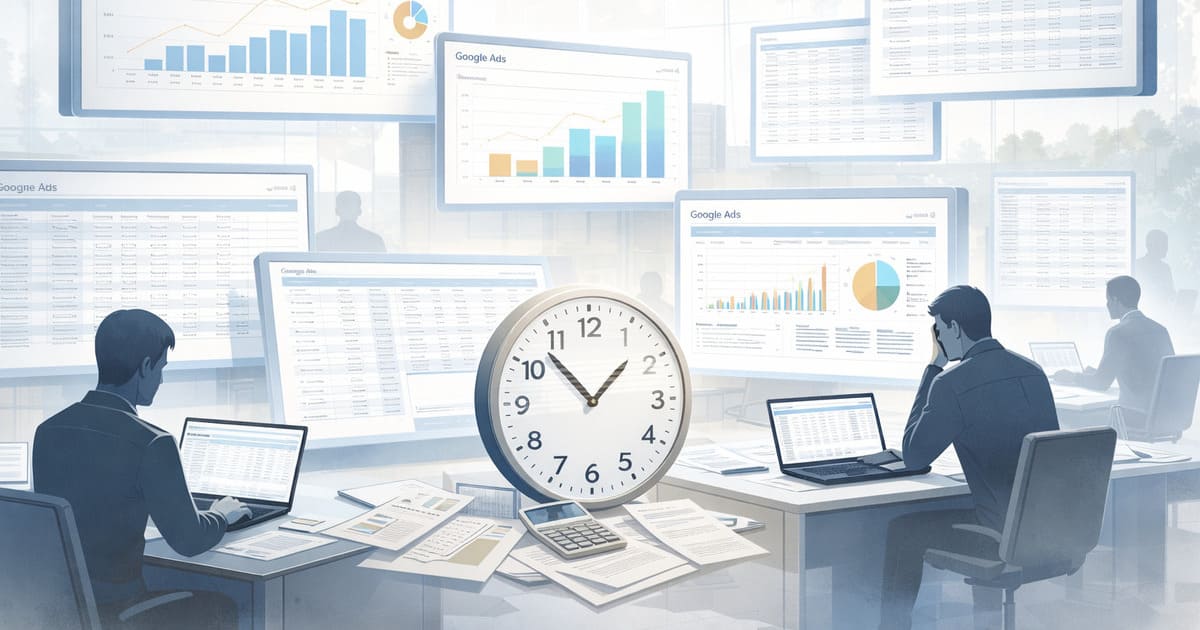
The agency’s operations team depended on manual Google Ads data extraction and spreadsheet manipulation. Each reporting cycle required exporting campaign metrics, validating data by hand, formatting reports, and reconciling inconsistencies across accounts.
As client volume increased, reporting delays became unavoidable. Leadership had no current view of campaign performance, only static snapshots that aged quickly and were hard to act on. Every manual step was another chance for a data error, so nobody fully trusted the numbers behind optimization decisions.

The Automation Objective
Few Good Geeks set out to build real-time Google Ads performance reporting that no longer depended on a person repeating the same tasks every cycle. Data collection, validation, enrichment and delivery all had to run automatically, while staying transparent and easy to audit.
It also had to keep up as the agency grew, without adding workload or hinging on any one member of staff.
In practice, reporting had to stop depending on whoever was free that afternoon. If a report only appears because a specific person remembered to export it, that is a habit, not a system.
The Implemented Solution
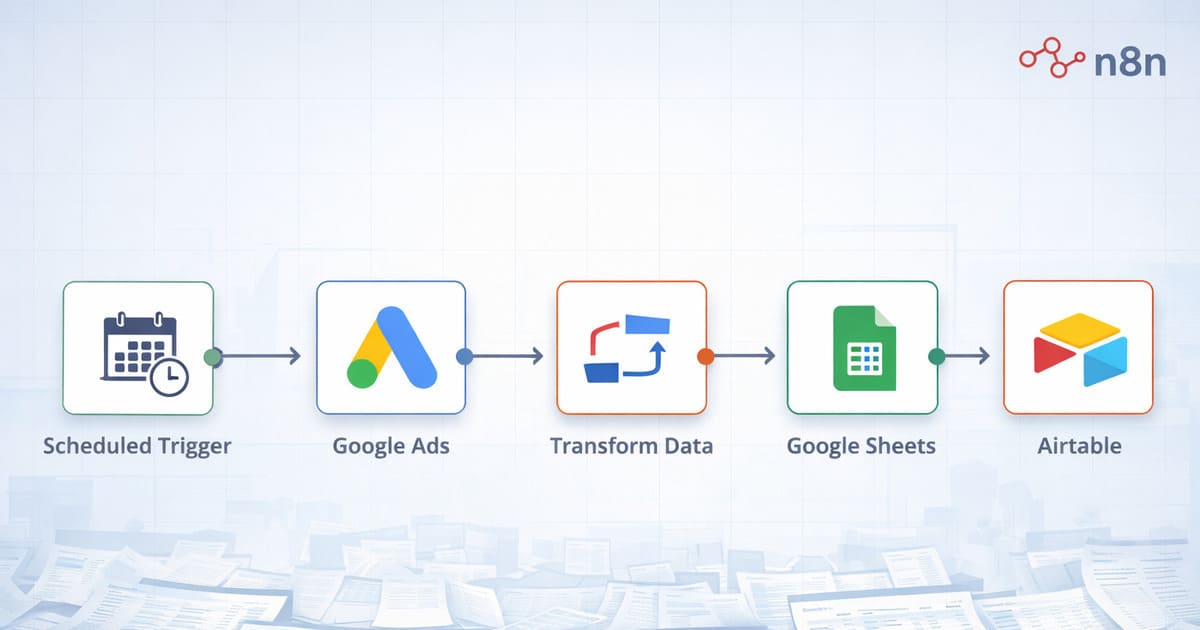
We built the AI-assisted workflow in n8n, which handles the orchestration. A scheduled trigger sends authenticated API requests to Google Ads and pulls campaign-level metrics, including impressions, clicks, spend and conversions.
The incoming data then goes through validation logic that standardizes the metrics, flags anomalies and checks that nothing is missing. Validated data is written to Google Sheets for the client-facing reports and synced to Airtable, which holds a structured history the team uses for analysis and control.
Automation Intelligence in Practice
The workflow does more than move data from one place to another. Conditional logic sets incomplete records aside, marks outliers and applies the same formatting rules to every report it produces.
People only review the exceptions, so real-time Google Ads performance reporting works the same way however many accounts the agency adds. AI handles the exceptions and automation handles the rest, the split we describe in AI automation that saves time.
When something does look off, the team sees which account, which metric and which run produced it. A human can decide in minutes instead of rebuilding the sheet to find out.
Operational Impact
After launch, the agency saw these changes:
- 8 to 12 hours per week reclaimed from manual reporting
- Reduced error rates caused by spreadsheet manipulation
- Faster access to campaign insights for optimization
- Improved confidence in reporting accuracy
Operations managers can check campaign performance whenever they need to, and leadership gets current numbers it can rely on.
Scalability and Governance
The reporting system was built so the agency can see and control everything it does. Every step of the workflow is visible in n8n, so the team can monitor it, audit it and change it safely.
Adding new clients and campaigns does not add operational work.
Why This Matters
In small and mid-sized businesses, manual reporting eats into productivity, and the process tends to stall whenever the one person who knows it is away. This project shows how AI-powered Google Ads campaign performance automation turns reporting into infrastructure the business can depend on.
The team gets its hours back, decisions happen sooner, and reporting no longer stops when someone is busy.
Service Alignment
This project is a good example of Few Good Geeks’ AI-Assisted Operations Automation service. We build systems that take repetitive operational work off people’s desks, add AI where fixed rules are not enough, and keep working as the business grows.
Beyond the reports themselves, the agency now has a setup it can keep building on as it takes on more clients.
Human hours saved per week
Reduction in manual reporting effort
Automated Google Ads data ingestion
AI-Assisted Operations Automation
This project was delivered through Few Good Geeks’ AI-Assisted Operations Automation service, which turns recurring operational work into automation that stays governed, grows with the business and saves hours you can actually measure.
Because 21+
Companies Hate Wasting Time Too



Federation-Level Technology Allies
A carefully selected crew of partners who know their tech, respect the mission, and deliver without excuses. From AI automation to engineering precision, these are the people we trust to help us move faster, smarter, and with fewer red alerts along the way.